The Mesmerist’s Daughter is launched!

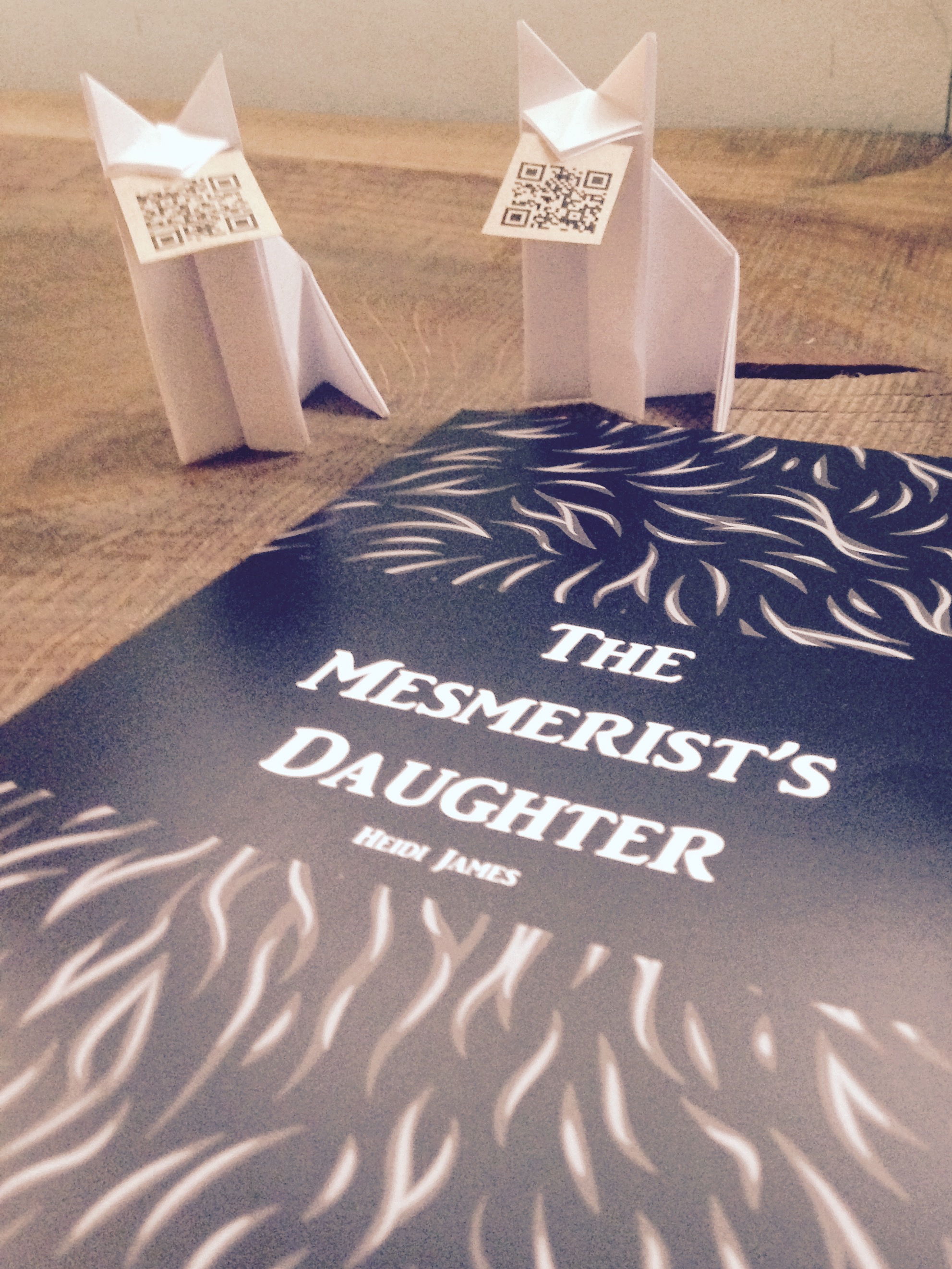
Neon Books has published my novella, The Mesmerist’s Daughter and it looks great.. you can get your copy here (print and digital) for only £4. Get in quick to receive one of the origami wolves!

Still not tempted? Here’s an extract to whet your whistle…

My mother was a wolf. That was the first secret I kept for her. At night she would jimmy open my door with her muzzle and swagger into my bedroom, her blunt claws clicking like tarts’ heels on the floor, her panting rigid and dependable. Her thick, wiry pelt was heavy and as smothering as coal gas.

During the day she hid her grey wolfishness under a human costume. I played at being a hairdresser and brushed her human hair looking for gaps in her pretend skin where wiry fur might poke through. She was very thorough. I never found a thing. When I woke before her alarm went off I sneaked to her room to try and catch her as she snapped and crunched her bones, flattening the long wolfy snout, before cramming it into a flat-face human mask. I was always too late; when I got there she was drawing her lipstick on her mouth, smoothing her skirt over her bottom.

But every night the same thing: in she’d come, tap, tap, tap, snuffling under the cover, her stinking breath hot on my skin, and she’d eat all my belly flesh from rib to hip, tearing and ripping, chewing with her mouth open, eaten dry, nothing left of me just leg, leg, arms and a head. All the while I watched her, mesmerised. I didn’t feel a thing except sleepy, so sleepy, and by morning I was whole again, like myself only newer and weaker. That was the first of many secrets.

FullSizeRender

Anaesthetized: Modern Life Numb Bodies

I love doing research for my work, and not just as an act of barely disguised procrastination, but because I never know quite what I’ll discover about my fellow crazy flawed humans. Mostly I have a sense of what I’m looking for, but sometimes I stumble on a world by chance, and these rare opportunities have never failed to inspire. One of these moments — a fortuitous introduction, a lucky break (she liked my face) — found me observing a dominatrix at work in her dungeon.

She worked from a large flat in the city and was highly regarded, receiving large gifts of cash from her ‘guests’. As expected she was dressed in black leather and wore thigh high boots; the main playroom was lined in padded leather pinned by buttons like a chesterfield sofa. Various implements hung from racks on one wall. We chatted about her work, the scenarios and punishments requested by her submissives and the price of real estate, the difficulty of finding builders with the discretion to install suspension racks and sound proofing.

I wanted to know why these men (it was mainly men who visited her, though she knew of a Dom who saw exclusively female submissives) came to her to be beaten and humiliated, as sexual release — in the ordinary ‘vanilla’ sense — wasn’t part of the deal with her service. ‘These guys are CEOs, lawyers, bankers. High achievers. It’s about control,’ she said, ‘they’re sick of making decisions, choices. They want someone else to take charge.’ Given permission to speak with a couple of her ‘guests’ they confirmed what she said, one adding that the incredible endorphin rush he had after being whipped was ‘better than sex, better than any drug.’ He boasted ‘I feel alive when I leave here, after feeling numb most of the time.’

Never before in the Western world have we had so much choice, from the food we eat, where we spend our vacation, to how and when we procreate, to the nuanced expression of our identity — so long as you have the financial means, of course. We’re assaulted by continual stimuli and demands on our attention in the modern world, with so much choice that we’re paralysed and unable to act — what Swartz called The Paradox of Choice. Where once we had much of our lives dictated to us by our family and societal expectation, now consumerism demands we assert our individualism and make myriad choices that promise to give ultimate happiness and self-expression, though we know of course, these choices are manipulated and cajoled by the market and it’s lieutenant, Culture and the media; ultimately we find ourselves exhausted and depressed.

The clients visiting the Dominatrix had found a way to untangle themselves, momentarily, from the demands of their world, by giving up control they found a space to just be. So when I was writing my last novel, Wounding, I knew just how Cora (the protagonist, a woman lost and numbed by the shock of motherhood) would try to find herself and attempt to recover. It’s not so simple of course, but how we choose to find solace amidst the noise and fuss of the modern world continues to fascinate me — I just didn’t expect to find a potential answer in a Dominatrix’s parlour.

Bad Mothers – the worst taboo?

What a relief to hear the writer Ayelet Waldman, author of Love and Treasure, exhort mothers to tell the truth, “even – no, especially – when the truth is difficult”. (Guardian, 19/04)

Not only is motherhood not always what it’s cracked up to be, but women are left isolated and sometimes, children put at risk, as we are too afraid to ask for help or let off steam by talking honestly. It’s time to tell the truth. Mothers, shout it from the rooftops.

We don’t want to hear a mother’s truths: we don’t want to know about her struggle with herself as she wrangles her children. We don’t want to know about her resentment or even hatred for her child; we close our ears when she lets slip that she finds motherhood boring, unfulfilling or terrifying. We want mothers to hide their complexity because complexity maketh a monster.

As a mother, I, too, have hidden behind the lies and half-truths, been ground down by the political and patriarchal policing of motherhood that Waldman writes about. I, too have been a member of that exhausted congregation, soaked up each commandment on perfect parenting. You’re not feeding them right. You didn’t breastfeed long enough. You’re allowing too much screen time. You swear too much. Let alone the questions that trap women in the good-bad, angel-monster dichotomy of femaleness: are you back in your pre-baby jeans? Bonding with the child? Having enough sex? How’s that career? House looking beautiful?

Despite having close relationships with other women in which I can discuss many intimate details of my life, there exists a taboo against admitting that we might not find motherhood as satisfying or riveting as we’d hoped. Though I adore my children there have been times when if I could have, I’d have handed them back. But would most women admit that? Not a hope.

As a daughter I have viewed my own mother through the lens of fear and loathing because she didn’t fit the “good mother” mould. As a little girl I remember my horror as she told me not to call her “mum” and warned me off having children. What freak would describe being a mother as “hell on earth?” Raising three children alone, she was no freak, I see now, but a young woman under pressure who sometimes resented her children.

As a young girl I couldn’t see her as human, as having needs that weren’t being met. As a woman, and now, as a writer, I see the horrendous strain she was under.

As a novelist I’ve freed myself. My need to understand my mother’s ambivalence, to reclaim my own complexity and to find empathy, led me to Cora, the protagonist of my novel, Wounding.

Cora is, in fact, the everywoman; the ‘everymother’. She is knotty, broken in parts, confused; so damaged by what she perceives as her “lack” that she looks for punishment in self-harm. She, like so many mothers, is at risk of being completely subsumed.

“She pictures the children, their demanding, clutching limbs, their hungry faces, their toes and fingers, grasping, grasping. Natural demands that ask too much of her. She is defined by what she is unable to give. She is defined by her lack. She is lack, a void, a blank space that devours. Takes, takes, takes. She cannot give.”

I created Cora because I wanted to write from a female point of view that wasn’t simplistic. I didn’t want to reduce her to a stereotype. I wanted to test the reader: can you feel compassion for this flawed woman? Cora struggles to fit the expectations of her family and wider society. Does this make her normal or deviant? Unnatural? An aberration?

I was prepared for some backlash to Wounding but I’ve been surprised by how many readers, in particular, women readers, have identified and empathised with her struggles.

There’s nothing ‘natural’ in our current blueprint for motherhood; as Waldman tells us too, women are the primary authors of our own subjugation. I want the story of motherhood to be rewritten, for just as women have begun to claim some equality we are reminded that we aren’t ready yet to be individuals, with our own motivations, tastes, passions and fears. We are trapped in the dichotomous territory of femaleness: good or bad, angel or monster.

Him

My daddy was killed whilst on active service

In Ireland

By the IRA.

Or so I thought.

When I was five.

Because I’d never met him, or heard mention

Ever

And every one else had a dad

Except me, so he had to be dead

And a hero. I thought

But actually

He lived up the road

With his other kids

And when I finally met him

I was fourteen years old

He was definitely alive

And not much of a hero.

But had a ponytail

And a cheap sports car

And a young girl friend

Who had tried to be a model

And who got me pissed on

Margaritas for my 15th birthday

Though it wasn’t glamorous

When I spewed down my school

Uniform on the way home

And my mum

Clipped me round the head and told me to stop acting like a slag

And when I was seventeen and a bridesmaid at his last wedding

He said

‘You want me to fuck your friend so you can find out what it’s like’

And he used to tell me how he loved to cuddle after sex

And he asked if he could watch me kiss another girl.

Because he has the gift

And can see ghosts

And they tell him the secrets

Of the universe

And once he did an excorcism

Releasing the bad spirit into an oak tree

He says his spirit guide is a red Indian

Who gives him his poetry

And that everything I am

Is because of Him.

Strangers

We haunt these streets, you and me,
Ghosts, but we’re not dead.
I saw us
yesterday
Outside our restaurant, kissing
Your hands pressed into the small of my back
Not caring about the cold.
A girl in chef’s whites leant against the brick wall, her hands cupping a cigarette, its Hot tip turned in towards her palm, not seeing.
Only I watched us.
Standing there in the dark
Only I see us clearly, for what we were.
What we still are.
Spectres. Repeating the same actions. Caught in a loop.
Suspended in time.
Before we were strangers
Before.

Writing Process Blog Tour

The marvellous Salena Godden invited me to join the Writing Process Blog Tour, answering the questions below before nominating other writers I admire to continue the tour… Watch out for Springfield Road AND Fishing in the Aftermath – Salena’s memoir and poetry collection, both out this year.


  1. What am I working on?


As always I’m juggling a few projects, not sure if this helps my process or hinders, but it’s how I work. So, I’m writing my next novel, So the Doves, meddling with two plays I’ve drafted and reworking The Mesmerist’s Daughter for re-release with Neon Press. There’s an academic essay sitting on my desk too and some poems… I have a very messy brain. Plus I’m leading workshops, performing and hoping to perform some more. With a bit of luck, So the Doves will be finished by December and I can get stuck into another novel that’s been hanging around in my head for a while, Salt and Ashes.


  1. How does my work differ from others in its genre? 


That is a crazy question. I don’t work to a specific genre or think in those terms. I write about what interests me, in a way that I hope engages with the characters and their world. I try to write about people that aren’t usually the focus of literature, but I’m not alone in doing that. Readers are usually the best judges of what is unique to a writer’s style. All I can do is write the way I write… If I tried for originality, I’m afraid it would be too self-conscious and mannered, which is definitely NOT what I want.


  1. Why do I write what I do?


To understand, to look deeper and more clearly. All writing is political – consciously or not. I grew up in a working class family, on a council estate – a lot of my fiction addresses issues that stem from that, even covertly. I try to write about characters to reveal their complexity, their ‘dependent origination’, if you like, so as not to reduce them to stereotypes – whether that’s about gender (in WOUNDING) or poverty and education, (in So the Doves). I know it’s a cliché, but I feel that I don’t have a lot of choice… Like most writers I have my obsessions, my ‘thing’ that I’m working through. I don’t want to write to provide answers however, I write to begin the questions.


4. How does my writing process work?


I write around 2000 words a day, Monday to Friday unless I have a deadline. When I sit down to write it comes fast, but I can sit on an idea for ages, making notes, writing fragments, planning, creating character profiles – I fester in it for a while and then it begins. Short stories I tend to write in one sitting, and then edit over the next couple of days. I was incredibly lucky to work with an amazing editor for WOUNDING, that was a fantastic experience, having someone you trust read what you’re doing and giving you honest, skilled feedback. I have my routines – but nothing superstitious – I walk the dog, run, do yoga, meditate – all that stuff and then sit down at my desk and get on with it.


Right! Back to it… Thank you for reading this far, let me know how you go about your creative process. It’s now my pleasure to hand over the Blog Tour to one of my favourite writers, Rebekah Lattin-Rawstrone, her novel, HOME, published by Red Button Booksis a brilliant, unsettling story and I highly recommend it.


Rebekah Lattin-Rawstrone’s first novel, Home, is published by Red Button Publishing. She is currently working on a collection of short stories, her second novel, a series of picture books for the under fives, and a blog tracking her attempts to read a novel a week for a year. Rebekah also teaches creative writing for City University.


Stranger than the Past.

‘They say you can’t change the past,’ Alison said.

‘Who does?’ smiled Adam.

‘They do, agony aunts, cod philosphers, various songs, but we know it changes all the time, don’t we?’

 Stranger Than Kindness, Mark A. Radcliffe.

I’ve just finished reading Radcliffe’s novel. It carefully exposes the troubled world of mental health professionals, as gently as a thumb testing flesh for a wound. This isn’t a review of course, but it is wonderful book and I recommend it. This is where the book has brought me. I grew up close to madness, and if that sounds as though it were a place, that’s because that was how it seemed. Like a crumbling, smelly old house that you never wanted to visit, somewhere you could avoid, that you could chose not to enter. Madness – in its various forms, runs through our family; a germ coiled in the blood. Though in our family it wasn’t acknowledged as a genuine condition, only that someone was ‘attention seeking’. No one ever made the point that it was pretty extreme way to get noticed.

I’ve been in an asylum or psychiatric unit as they’re called now, several times. The first was when I was a little girl, visiting my grandmother. She sat in a plastic covered armchair along with all the other patients, placed uniformly around the edges of a large square room. My memory is sketchy, but I know that I didn’t recognise this woman who only looked like my nanna, her face blank, not laughing at my silly jokes and that I crawled slowly out into the centre of the room, the blue nylon carpet burning my knees, aware that I was alone in being able to leave the safety of the walls. My next encounter with mental health facilities was in a Hospital for the Criminally Insane, I taught there briefly, and my main recollections are being told not to worry that they didn’t have a personal alarm for me, because if I was attacked I’d be dead before they managed to help me anyway, making the alarm redundant and that the staff seemed more crazy than the patients. My final visit to a psychiatric ward was when I was admitted myself, knowing as surely as day follows night, that I was a horse or least that I had no words and only legs and that I would have to run. Or so I remember, having returned from that place a long time ago. I wonder though, if even putting that episode into words has sanitised it, made it something it wasn’t – which was understandable or knowable. The point is that it was beyond words, beyond narrative and telling. It was a radical uncertainty.

Radcliffe is right, the past does change, no matter what people say. It’s shifting and undoing the fragile selves we think we’ve secured for ourselves right now. So I am certain of nothing, except this moment.

A Wounding extract for Mother’s Day…


The large clock on the wall in the sitting room marks out time. Cora sits on the sofa, a book open in her lap. The house is quiet: empty. She is supposed to enjoy this emptiness, revel in the depths of the peace, the space, as if it were a hot spring she could sink herself into. As her husband left the house with the children he kissed her and said,

         ‘Have a little time to yourself, Darling. It’ll do you good. Perhaps open a bottle of wine or something. Go for a walk, watch a film. We’ll be back around seven…Ok, take care. We love you.’

         Sitting there, she feels time should open up before her, as if a gate were thrown wide revealing an expanse that she could disappear inside, but it doesn’t. It closes off, constricts as sure as a snare. They have gone for the day, he has driven them over to his sister’s house, where they will play with their cousins, shouting, dirty-faced yelps of excitement, running garden dirt through his patient sister’s house; she is a doting mother, their aunt, her sister-in-law. His parents will be there – the grandparents, the heads of the family. There will be absolute harmony. She won’t be missed, she is sure of that.

         Everything is demarcated, a territory, a place, the family, love, even sex. All relationships are territorial, marked off, divided from all the others, outsiders, instating privacy. There is no such thing as time only geometry, topography, the delineation of words, shared interests, history. The only unity Cora can understand is spatial. She consists of spaces, gaps between matter, she slips between time. She takes up space on the sofa. Breathing.

An extract from WOUNDING…A sneak peek for you, Happy Valentine’s Day! x

I walked you home, side by side. I still hadnt touched you, not even a brush of fingers. My whole body seemed to vibrate with the intensity of being near you. I felt like we werent just two individuals walking along, but like some kind of energy connected us, that we were set apart from everyone and everything around us. I asked you where you grew up and went to school. You looked up at me and said, Nowhere special. like that was enough of an answer. And you just stood there, looking up at me. Whilst my fingers played with the cold, sharp weight of my keys, wondering if now was the time to kiss you. Like comedy, timing is everything for the first kiss. I didnt want to mess it up. I wanted to impress you, to impress myself on you. A car crawled past us, its music blaring out. I let it pass. You cleared your throat and looked down at your feet. I stepped forwards, took my hands from my pockets and with my hands around your waist, pulled you towards me. You were perfect. You tipped up your face and waited as I bent to your lips.